
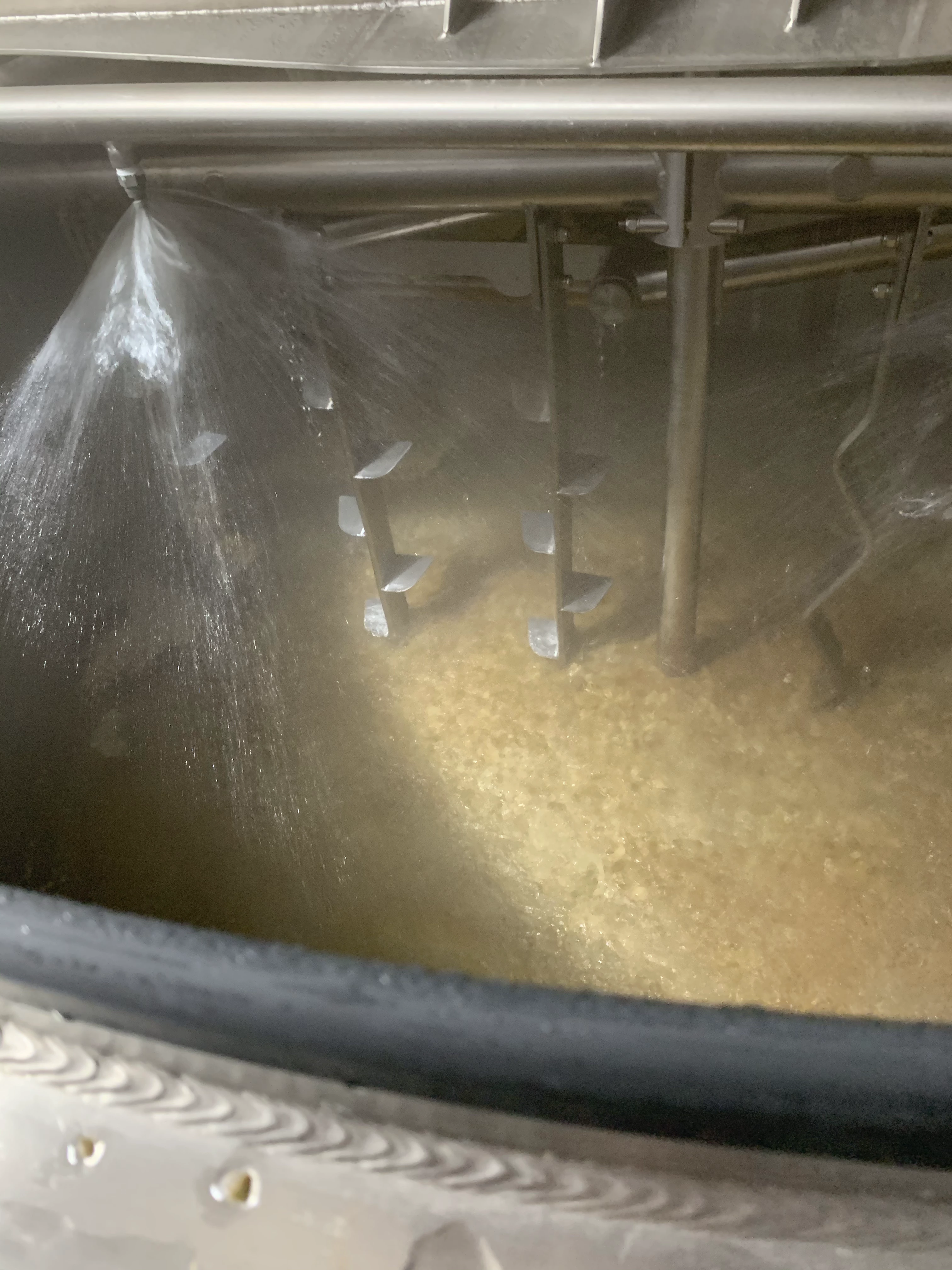
If there’s still residue in your tanks after a wash, your CIP system design needs a closer look. Solon designs the cleaning circuit, supplies the equipment, programs the controls, and commissions the system for food and beverage makers. Our founders own and run their own operation, so equipment choices are decisions we make for ourselves, too. You’ll need records showing that the wash reaches the surfaces that touch your product and cleans, sanitizes, or sterilizes them to the level your process requires.
In a brewery, winery, distillery, ready-to-drink operation, or food business, follow the wash through tanks, piping, valves, fillers, pasteurizers, heat exchangers, filters, transfer lines, hoses, and drains. Check chemicals, water, steam, instruments, PLC logic, and operator records, too. To talk to a beverage consultant about your wash, send us your tank list.

Check your piping and tanks before you choose a CIP skid
Before buying a skid, check the wash route through your equipment. Pipe slope, dead legs, mixproof valves, spray coverage, pump size, dosing, return temperature, and measurement points need to work together. Custom CIP equipment for food processing needs the same attention to the circuit.
- Confirm every product-contact surface is reached
- Match flow, temperature, chemistry, and time to soil load
- Capture records operators and auditors can use
- Validate high-risk cycles before relying on them
How long, how hot, and which chemicals does your wash need?
If your wash leaves residue, check its time, action, chemistry, and temperature, often called TACT. Adjusting one affects the others. More heat or time may help; check the result and whether that cycle is practical on a production day.
Give each wash step enough time to work. Set cycle duration, chemical contact time, drain steps, soak periods, and the required hold time.
Does the wash reach the residue? Check flow velocity, turbulence, spray coverage and impact, valve pulsing, and the liquid’s return.
Which chemicals does your wash need? Specify caustic, acid, sanitizer, conductivity targets, concentration checks, equipment compatibility, and safe chemical handling.
The temperature at the return matters, too. Check supply and return temperatures, heat-up time, heat loss, chemical effectiveness, and material limits.
For each setting, specify the required value, measurement point, and allowed tolerance. Decide which reading triggers an alarm or stops the cycle, and who checks the record. Your operators need to see what happened during the wash.
What needs checking in your CIP system design?
| Equipment being cleaned | What to check before buying | Records and checks to keep |
|---|---|---|
| Tanks and vessels | Do spray devices reach the full surface, including manways, shadows, agitation hardware, and high-risk residue areas? | Spray device data, coverage review, flow/pressure records, riboflavin or coverage test where appropriate |
| Process piping | Are velocity, slope, drainability, dead-leg limits, valve positions, and return paths adequate? | P&ID review, circuit maps, flow records, drain checks, and valve-state verification |
| Heat exchangers | Can fouled surfaces be cleaned without bypassing plates, tubes, gaskets, or hold sections? | Temperature trend, differential pressure trend, chemical record, inspection findings, and corrective action history |
| Fillers and packaging paths | Does the cleaning path reach product-contact components without creating contamination during reassembly? | Changeover procedure, sanitation record, pre-op check, swab or ATP records, and line-release signoff |
| Filters and membranes | Are materials compatible with chemistry, temperature, pressure, and recovery expectations? | Vendor limits, cycle recipe, integrity checks, flush records, and replacement criteria |


What should CIP and SIP controls record during each cycle?
If operators keep stepping in during a wash, check the controls. The program should enforce recipe steps, valve positions, pump start conditions, dosing, temperature holds, return conductivity, drainage, alarm responses, and completion rules. Repeatable controls depend on piping and tanks that can be cleaned.
If your process needs steam sterilization, check the SIP cycle separately from the liquid wash. Steam quality, air removal, temperature mapping, condensate drainage, and pressure control affect the result. Define the area that must stay sterile and how you’ll protect it during cooling before relying on that cycle for a critical process.
Before production, walk the circuit and check it against the cleaning procedure. Confirm valve positions, challenge alarms, test dosing, check instrument locations and drainage, and compare the recorded cycle with the procedure. Our CIP validation page covers accepting the wash; our food process validation guide explains checks across the process.
Write down what counts as a passing cycle before using the system. Set responses to a short step, low return temperature, manual override, or missed conductivity target. Your operators shouldn’t have to decide on the spot how far a wash can depart from the procedure.
| Record Type | Why It Matters | Typical Review Question |
|---|---|---|
| Cycle recipe | Defines required time, temperature, flow, chemistry, valve states, and permissives | Does the approved recipe match the validated or accepted procedure? |
| Trend record | Shows actual process behavior during the cleaning or sterilization cycle | Were critical values achieved at the right measurement points? |
| Deviation record | Documents incomplete cycles, alarms, manual overrides, or missed criteria | Was product-contact equipment held from use until the issue was resolved? |
| Verification record | Links cleaning performance to inspection, swab, ATP, micro, allergen, or chemical checks | Does evidence support release of the equipment for production? |
| Change record | Controls recipe, chemical, equipment, instrument, or process changes | Did your team check the need for revalidation or extra verification before using the changed cycle? |
Where can a cleaning or steam cycle go wrong?
- Dead legs, poor drainability, or valve positions that leave soil behind
- Spray devices sized for static rinse rather than the actual residue load
- Return temperature or conductivity measured too far from the true worst case
- Manual steps that are not alarmed, recorded, trained, or reviewed
- SIP cycles without air-removal, condensate, or sterile-boundary evidence
- Recipe changes made without sanitation, quality, and engineering review
Your questions about cleaning and sterilizing equipment
Does every beverage cleaning circuit need validation?
The validation and verification needed depend on food safety, quality, and regulatory risks. Cleaning steps that control hazards need stronger evidence than rinses of equipment that doesn’t touch product. Check what your circuit requires.
What’s the difference between a CIP wash and a SIP cycle?
CIP uses controlled liquid cycles to clean or sanitize equipment without taking it apart. SIP uses steam to sterilize or apply a specified heat treatment in place. Check steam quality, air removal, temperature distribution, condensate drainage, and protection of the area that must stay sterile.
Which readings should we record during a CIP wash?
Record supply and return temperatures, flow or pump state, conductivity, chemical dose, valve position, pressure, step time, tank level, and drain state. Include alarms and operator changes. The readings you need depend on the circuit’s risks and the procedure you’re checking.
When should we check or change our CIP recipes?
Check recipes after equipment, product, allergen, chemical, or control changes, and after sanitation failures, environmental findings, or repeated operator overrides. Regular checks also help catch gradual changes in the wash before you’re deciding if equipment is ready for the next batch.
FDA rules to check when writing cleaning procedures
- 21 CFR Part 117: CGMP, Hazard Analysis, and Risk-Based Preventive Controls for Human Food
- FDA Current Good Manufacturing Practices for Food and Dietary Supplements
Need a CIP skid or help with a steam cycle?
Send us the circuit drawing or describe the wash problem. Solon designs the circuit, specifies and supplies the skid and equipment, builds and programs its controls, helps with installation, and commissions the system. An engineer reads your inquiry and replies by email, usually within one business day. Our beverage consulting company also helps with the equipment around the skid.
More on piping, controls, and cleaning chemicals
- Sanitary process design for food and beverage equipment
- Food engineering consultants for your piping and equipment
- PLC and HMI integration for your cleaning controls
- Food and beverage consulting for your next equipment project
Use measurements from your wash to set the chemical dose. Our free CIP chemical dosing calculator converts target strength into stock chemical volume and cost per cycle.